SKYUP Trampolines with Windproof Enclosure & Basketball Hoop

SKYUP trampolines are built on 1.5mm galvanized steel frames β€” the same rust-treated construction that outlasts painted mild steel by years in real outdoor conditions. The windproof enclosure net and basketball hoop (included on the Black 2026 model) make every session safer and more fun. The 16 ft trampoline model holds 8 to 10 simultaneous jumpers, which means the teenager and the toddler and the parent who wants to join can all be on it at once. Every tranpoline ships ASTM F381-16 certified, with a no-gap inner enclosure net that attaches directly at mat level to eliminate the pinch point where most enclosure injuries happen. The Black 2026 model also includes LED lights, a sprinkler, a ladder, and jump socks β€” no separate purchases needed.
βœ“ 1,500 lbs capacityβœ“ No-gap inner netβœ“ Lights + sprinkler included
Check Price on Amazon
SKYUP 2026 Upgraded 8 10 12 14 15 16 FT 1500lbs Tranpoline for Kids and Adults with Light+Sprinkler+Socks
No Gap Between the Mat and Net

The inner enclosure net attaches directly at mat level, eliminating the exposed gap where most spring-area pinch injuries occur β€” 12 foam-padded poles (11mm thick) mean perimeter contact hits foam, not bare steel.

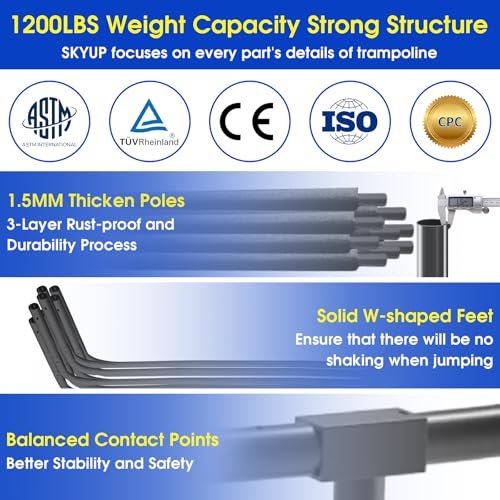
1.5mm Galvanized Steel Outlasts Painted Frames

SKYUP uses black-spray galvanized 1.5mm steel tubing β€” zinc-bonded to resist oxidation β€” while most budget competitors use painted mild steel that begins rusting within one or two outdoor seasons.

Six Sizes, Up to 1,500 lbs Capacity

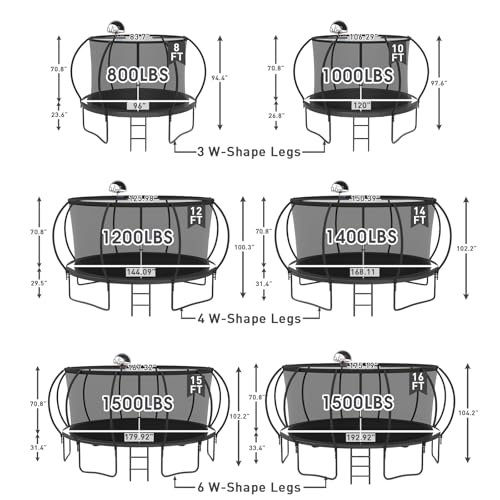
Eight feet through 16 ft, with static weight capacities scaling from 800 lbs to 1,500 lbs β€” the 16 ft model is tested for 8 to 10 simultaneous jumpers, including adults.

Every Accessory Ships in the Box

LED lights, sprinkler, basketball hoop, ladder, and jump socks are all included with the Black 2026 model β€” packed in a separate small box alongside the main hardware, nothing to order separately.

SKYUP Trampoline Models β€” Three Colorways, One Platform

All three SKYUP models share the same galvanized steel platform, no-gap inner enclosure, and ASTM certification β€” the differences come down to colorway, included accessories, and a few design details worth understanding before you pick one. Here's what separates them.

SKYUP 2026 Upgraded 8 10 12 14 15 16 FT 1500lbs Tranpoline for Kids and Adults with Light+Sprinkler+Socks

2026 Upgraded Trampoline with Lights (Black)

The flagship model in SKYUP's lineup β€” 440 reviews, 4.4 stars, and the only one carrying the 2026 designation. Snap-button T-shape connectors make pole assembly faster than the previous design, and the full accessories bundle (LED lights, sprinkler, basketball hoop, ladder, socks) is included across all six sizes. Spring count runs from 48 on the 8 ft up to 108 on the 16 ft.

The most complete setup SKYUP offers β€” if you want lights for evening use and a sprinkler for summer afternoons without ordering anything extra, this is the one.

See on Amazon
SKYUP Tranpoline 1500LBS 16 15 14 12 10 8 FT Tranpoline for 7-10 Kids and Adults

Heavy Duty Trampoline with Wind Stakes (Blue)

The blue variant adds a 4-piece wind stakes kit as a standard inclusion β€” not an add-on β€” which makes it the practical call for families in windier parts of the country. It also ships with a double-lock enclosure net (double-side zipper plus 2 buckles) and an upgraded top-cap ring that keeps the net from sagging or dropping. Rated 4.1 stars across 225 reviews.

If you're in a windy climate β€” Texas Gulf Coast, the Great Plains, anywhere storms roll through regularly β€” the included anchor kit alone makes this the smarter choice over the black model.

See on Amazon
SKYUP Tranpoline 1500LBS 16 15 14 12 10 8 FT Tranpoline for 7-10 Kids and Adults

Windproof Heavy Duty Trampoline (Green)

The green model carries the same structural specs as the rest of the lineup β€” 108 springs at 16 ft, 6 W-shaped legs, 1.5mm galvanized steel, no-gap inner net β€” but doesn't include the LED lights, sprinkler, or socks bundle. Wind stakes and a basketball hoop are still included. It's the right call if you want SKYUP's core build without paying for accessories you won't use. Rated 4.2 stars across 60 reviews.

Same frame and enclosure engineering as the flagship at a stripped-down bundle β€” choose this if the accessories aren't a priority and the green colorway fits your yard better than black or blue.

See on Amazon

Which SKYUP Size Fits Your Yard and Family

The right SKYUP size comes down to two numbers: how many people will jump at the same time, and how much open yard you have. Get both right and you'll use this trampoline for years. Get either wrong and you'll either feel cramped within a season or spend a weekend returning a frame that doesn't fit your space.

SKYUP 2026 Upgraded 8 10 12 14 15 16 FT 1500lbs Tranpoline for Kids and Adults with Light+Sprinkler+Socks

How Many Jumpers at Once

This is the question that actually decides your size β€” not age, not a single person's weight, but simultaneous use. A family with four kids who all want on at the same time is a different trampoline situation than a family with one 7-year-old who jumps solo every afternoon.

  • 8 ft (48 springs, 3 legs): One to two kids, ages 3–8. Best as a single-jumper setup. Fine for a toddler who wants to bounce in the backyard without turning it into a full family activity.
  • 10 ft (54 springs, 3 legs): Two to three kids with some simultaneous use. Gets tight fast if older siblings want in.
  • 12 ft (64 springs, 4 legs): Three to four kids for casual family use. Handles light adult jumping. This is the size that feels spacious at ages 6–8 and starts feeling crowded at ages 10–12 with three active kids.
  • 14 ft (80 springs, 4 legs): Four to six kids, or two to three adults at once. The sweet spot for families with a wide age range β€” the 7-year-old and the 13-year-old can both be on it without a fight over real estate.
  • 15 ft (96 springs, 6 legs): Similar capacity to the 16 ft, with slightly more edge clearance per jumper. Good when teenagers are the primary users and you want that extra surface without going to the largest footprint.
  • 16 ft (108 springs, 6 W-shaped legs): Eight to ten kids or three to six adults simultaneously. This is the right call when adults plan to jump regularly, or when you have a large family where "everyone" genuinely means everyone.

One note on the 12 ft: it uses 4 U-shaped legs with 8 ground contact points. The 14, 15, and 16 ft models switch to W-shaped legs β€” the 14 ft gets 4 W-legs, the 15 and 16 ft get 6. That's not a minor detail. W-shaped legs spread the load across two contact points per leg instead of one, which is what keeps the frame from rocking when a 200-lb adult and two kids are jumping at the same time. If you're on the fence between 12 and 14 ft and adults will jump regularly, the leg geometry alone is worth considering.

The "Grows With the Kids" Question

Parents ask this constantly: should I size up now to accommodate heavier, taller kids in a few years? Honestly β€” yes, if your yard and budget allow it. Spring tension and frame capacity don't scale up as kids grow, but kid weight does. A 10 ft that's perfect for a 60-lb 7-year-old is going to feel undersized and overstressed at ages 11 and 12 with two kids who each weigh 100 lbs. If you're choosing between 12 and 14 ft and your kids are currently 8 and 10, buy the 14.

When Smaller Is the Right Answer

If the yard is genuinely small and the primary user is one child under 10, a 12 ft is not a compromise β€” it's the correct trampoline. Don't buy a 16 ft for a single 6-year-old and a small suburban lot. The frame needs clearance, the assembly takes up an afternoon, and a well-sized trampoline used daily beats an oversized one that dominates the yard and gets used twice a week.

Planning Your Yard for a SKYUP Trampoline

Before you pick a size, measure your yard. The trampoline diameter is not the footprint you need β€” you need the diameter plus 3 to 4 feet of buffer on every side for safe clearance. A 16 ft trampoline needs roughly a 22–24 ft open circle. Ignore this and you'll either be trimming branches mid-assembly or returning the frame before it's finished.

The Clearance Math

Here's the rule: add 6–8 ft to your trampoline diameter to get the minimum open circle you need. That buffer accounts for a jumper who drifts toward the perimeter, the enclosure poles extending slightly beyond the frame, and adult-size bodies in motion. If you're tight on space, measure twice.

SKYUP 2026 Upgraded 8 10 12 14 15 16 FT 1500lbs Tranpoline for Kids and Adults with Light+Sprinkler+Socks
  • 8 ft trampoline: 14–16 ft open area minimum
  • 10 ft trampoline: 16–18 ft open area minimum
  • 12 ft trampoline: 18–20 ft open area minimum
  • 14 ft trampoline: 20–22 ft open area minimum
  • 15 ft trampoline: 21–23 ft open area minimum
  • 16 ft trampoline: 22–24 ft open area minimum

Overhead clearance matters too. Keep the site clear of low branches, roof overhangs, utility lines, and fences. The standard recommendation is at least 24 ft of vertical clearance above the mat surface β€” more than you'd expect, because a strong bounce on the 16 ft model gets you higher than most people anticipate.

Grass, Concrete, or Something Else

Grass is the right surface for a SKYUP trampoline. It gives the W-shaped legs grip without any modification, drains reasonably well after rain, and cushions a fall if someone somehow clears the enclosure β€” which is far less likely with SKYUP's inner net design, but worth considering anyway. Level the area before assembly if there's any slope. A trampoline on a 5-degree grade is a trampoline that wobbles, and one that wobbles under load is one that eventually shifts.

Concrete is not recommended. The legs have no give on a hard surface, which transfers more shock into the frame joints over time. If your only flat space is a patio or driveway, place rubber leg caps or thick rubber pads under each contact point to reduce that stress.

Rubber mulch or artificial turf both work fine, provided the surface is level and stable. Gravel is acceptable but not ideal β€” small stones shift under leg pressure and can create an uneven base over time.

Wind Stakes and Placement

SKYUP's blue and green models include a 4-piece wind stake set as standard. For the 16 ft model β€” which has 12 leg contact points across 6 W-shaped legs β€” the stakes anchor through the leg cross-members directly into the ground. If you're in a windy region (Texas, Kansas, the Great Plains corridor, anywhere with regular storm cells), use the stakes every time the trampoline is set up, not just during wind events. A frame that gets airborne during a storm is a hazard and an expensive loss.

Plan the placement so all four stake positions are in open soil β€” not over buried irrigation lines, cable runs, or shallow root zones. Mark your utility lines before you drive anything into the ground. This sounds obvious until it isn't.

One Measurement Before You Order

Walk the placement area with a tape measure before you click buy. Mark the center point and measure the radius in four directions. If any measurement comes up short, you need the next size down β€” or a different location in the yard. It's a 10-minute check that prevents a 2-hour assembly followed by a return shipment.

What the Weight Capacity Numbers Mean

The 1,500 lb figure on SKYUP's 16 ft model is a static weight capacity β€” the load the frame can bear without moving. It's not the weight of people actively jumping at the same time. Understanding that distinction is the difference between buying a trampoline that fits your family and being frustrated when it doesn't behave like the spec sheet implies.

Static vs. Dynamic Load

Static capacity measures what the frame can hold when that weight is just sitting there β€” no jumping, no impact, no movement. Dynamic load is something different. When a 150-lb adult jumps and lands, the impact force is a multiple of their body weight β€” typically 3 to 5 times, depending on jump height and landing technique. A 150-lb person landing from a moderate jump generates 450–750 lbs of instantaneous force on the mat and springs.

This is why SKYUP frames the practical capacity as "8–10 kids or 3–6 adults simultaneously" rather than "1,500 lbs of jumping weight." Those simultaneous-user figures are the numbers that actually matter for real-world purchasing decisions. A frame rated for 1,500 lbs static has been engineered and tested to handle the dynamic loads generated by those user counts β€” that's the engineering target, not the 1,500 lb headline.

SKYUP 2026 Upgraded 8 10 12 14 15 16 FT 1500lbs Tranpoline for Kids and Adults with Light+Sprinkler+Socks

Where the Misconception Comes From

One review that circulates on reseller sites reads: "Does not hold 1500 pounds." That's technically accurate and also misses the point. No recreational trampoline is designed for 1,500 lbs of active jumping weight β€” the static capacity figure is a structural engineering specification, not a "maximum jumper weight" claim. SKYUP uses 1,500 lbs because it's the correct structural language for this class of equipment, but the buyer-facing figure is 8–10 simultaneous jumpers on the 16 ft model.

If you're buying the 16 ft model specifically because you have a large family and want adults and kids on it at the same time, the relevant question is: will it hold three adults and five kids jumping together? Based on the 1,500 lb static rating and the 6 W-shaped leg configuration with 12 ground contact points, the answer is yes β€” that's within the engineered use case. A single 400-lb person jumping alone is a different question, and one we address in the FAQ.

Weight Capacity by Size

The capacity isn't flat across SKYUP's lineup β€” it scales with the frame. Here's how it breaks down:

  • 8 ft: 800 lbs static capacity β€” 3 legs, 48 springs
  • 10 ft: 1,000 lbs static β€” 3 legs, 54 springs
  • 12 ft: 1,200 lbs static β€” 4 legs, 64 springs
  • 14 ft: 1,400 lbs static β€” 4 W-shaped legs, 80 springs
  • 15 ft: 1,400 lbs static β€” 6 W-shaped legs, 96 springs
  • 16 ft: 1,500 lbs static β€” 6 W-shaped legs, 108 springs

Notice the 14 and 15 ft share a 1,400 lb static rating despite the 15 ft's larger mat and higher spring count. The extra springs on the 15 ft improve bounce consistency across a larger surface β€” they don't add structural load capacity in a way that changes the frame rating. If maximum simultaneous capacity is your primary concern, the 16 ft is the right choice.

SKYUP Safety Certifications Explained

SKYUP's ASTM F381-16, CPC, and CPSIA certifications aren't marketing checkboxes β€” each one covers a specific category of safety risk. Knowing what each standard actually tests helps you evaluate whether a trampoline's safety claims are real or just labels on a product page.

ASTM F381-16 and What It Actually Tests

ASTM F381 is the American Society for Testing and Materials standard specifically written for home trampoline equipment. The current version (F381-16) covers structural performance under load, enclosure net integrity under impact, spring cover pad thickness and coverage, mat tensile strength, and frame tube specifications. A product that meets F381-16 has been tested against defined failure thresholds in each of these categories β€” not just inspected and approved by the manufacturer.

The standard specifically addresses the enclosure net because net failure is a documented injury mechanism. SKYUP's inner net design β€” which attaches the net at mat level and wraps inward β€” is a structural approach that addresses the gap that exists in outer-net designs, where the enclosure net attaches outside the spring pad and leaves a narrow opening at mat height. Most spring-related entrapment injuries occur in that gap. The inner attachment eliminates it entirely.

CPC and CPSIA Coverage

The Children's Product Certificate (CPC) is the documentation that demonstrates a children's product meets the requirements of the Consumer Product Safety Improvement Act (CPSIA). Where ASTM F381-16 covers structural and mechanical safety, CPSIA covers material safety β€” limits on lead content, phthalates, and other substances regulated for children's products. Third-party testing is required; the manufacturer can't self-certify under CPSIA.

For parents buying a trampoline that children will be in physical contact with for hours at a time, CPSIA compliance matters beyond the structural specs. It means the mat material, foam padding, net fabric, and accessory components have been tested by an independent lab against federal chemical safety requirements.

No-Gap Inner Net Design

SKYUP's enclosure uses what the product specs call a "no-gap inner net design." Here's the engineering logic: in a standard outer-net enclosure, the safety net attaches to poles that sit outside the spring cover pad. The net hangs down from those poles and meets the frame at a point above the mat surface, leaving a gap between where the mat ends and where the net begins at ground level. A jumper who falls toward the perimeter can land in or through that gap, making contact with spring edges.

The inner design routes the net to attach directly at the mat perimeter β€” the net surrounds the jumping surface from mat level up. The spring cover pad then sits outside the net rather than inside it. There's no gap to fall through. The 12 enclosure poles β€” padded to 11mm foam thickness β€” are the structural supports for this configuration, and because they're inside-adjacent, any contact with a pole means contact with foam rather than bare steel.

What the Certifications Don't Cover

Honest point: certification standards test products as shipped and assembled per specification. They don't account for mat degradation over years of UV exposure, spring fatigue after several seasons of heavy use, or a frame that's been improperly assembled. SKYUP's polypropylene mesh mat is UV-resistant, and the galvanized steel springs are rated for weather resistance β€” but "weather-resistant" isn't the same as "weather-proof indefinitely." Inspect the mat and springs annually. Replace components that show visible wear. The frame is built to outlast the mat; the mat is a wear component.

Assembly Guide for Two Adults

Two adults, one to two hours β€” that's the realistic SKYUP assembly estimate, and it holds up for the 12 ft and smaller models. The 14, 15, and 16 ft models, which ship in two boxes, run closer to two hours when you factor in the parts inventory step at the start. Don't skip that step.

Before You Start

The 2-box shipment for larger models means parts are split across two cartons. Before you open a single instruction page, lay every component out and cross-reference against the numbered parts list in the graphic manual. This takes 15 minutes. It also tells you immediately whether anything is missing β€” and if something is missing, you want to know before you've assembled three-quarters of the frame, not after.

The graphic manual numbers every component and every step. SKYUP includes the spring tool in the package β€” you'll need it for the 64 to 108 springs depending on your size. Don't attempt to hand-stretch springs on a 108-spring 16 ft model. That's not a time-saver; it's a hand injury waiting to happen and a mat that won't tension evenly.

The Assembly Sequence

The general sequence across SKYUP models follows the same logic: frame legs first, then top rails, then mat, then springs, then spring cover pad, then enclosure poles and net. The 2026 Black model (B0BVQRMGPJ) uses snap-button T-shape connectors at the top rail junctions β€” these click into place rather than requiring force fitting, which makes the pole-to-rail connection noticeably faster than earlier connector designs.

One person holds the frame section while the other connects. That's the reason two adults are necessary β€” it's not about strength, it's about having a second set of hands to keep sections aligned while connections are made. Solo assembly of the 16 ft model is technically possible but practically miserable, and it usually shows up in the finished product as slightly misaligned poles.

The Accessories Box

The LED lights, sprinkler, and jump socks ship in a separate small box that arrives alongside the main trampoline carton (or cartons). This is easy to miss during unboxing, especially if you're unloading from a delivery truck. Check the full delivery before the driver leaves. The basketball hoop, basketball, and pump are in the main shipment; the lights, sprinkler, and socks are in the small auxiliary box.

Assembly for the accessories is straightforward β€” the LED lights attach to the enclosure poles, the sprinkler connects to a standard garden hose fitting at the frame perimeter, and the basketball hoop mounts to one of the enclosure poles. None of these require tools beyond what's already in the box.

Ground Conditions and Final Check

Level ground makes assembly easier and the finished product more stable. If you're on a slope, use a level on the frame rails during assembly rather than eyeballing it. Once fully assembled, give the frame a firm lateral push at the top rail β€” it should barely move. If it rocks, check leg seating at the contact points. On the 16 ft model with 6 W-shaped legs and 12 ground contact points, all 12 contact points should be in firm contact with the ground simultaneously.

The wind stakes (included with the blue and green models) go in after the frame is fully assembled and confirmed level. Drive them at a 45-degree angle through the designated leg anchor points. On soft Texas clay or loose soil, that 45-degree angle provides significantly more pull resistance than a vertical stake.

SKYUP Warranty and Parts Support

SKYUP covers the 16 ft model with an 18-month warranty and states a 24-hour response window for customer support inquiries. Both the blue (B0B5ZX4BG4) and green (B0BVG2P7QM) product listings confirm this warranty term; the black 2026 model (B0BVQRMGPJ) lists a 2-year manufacturer warranty in its tech specs. Check the specific listing at time of purchase for the warranty term on your chosen model and size.

What to Do If Parts Are Missing

The 2-box shipment for 14, 15, and 16 ft models is the most common source of post-delivery issues. Two boxes means two separate tracking numbers and β€” occasionally β€” two delivery windows. If Box 1 arrives and Box 2 doesn't, don't start assembly. Starting with incomplete parts and improvising mid-build creates misaligned components that are harder to correct once springs are attached.

If a part is genuinely missing after both boxes are confirmed delivered, contact SKYUP through the Amazon storefront β€” specifically the "Ask a question" function on the SKYUP store page β€” before attempting any substitution or modification. The product listings reference this channel directly. Keep the original packaging until assembly is complete and the trampoline has been in use for a full session β€” this is the most efficient way to document any component issue if support follow-up is needed.

Replacement Parts and Long-Term Ownership

Related searches for "skyup recreational trampoline replacement parts" confirm that buyers look for component-level support well after initial purchase. The practical longevity picture for a SKYUP trampoline is this: the 1.5mm galvanized steel frame is the long-lived component. The polypropylene mesh mat and the springs are wear items. UV exposure degrades mat fibers over time, and springs lose tension after years of heavy use β€” neither failure mode is a frame problem, it's a normal consumable replacement.

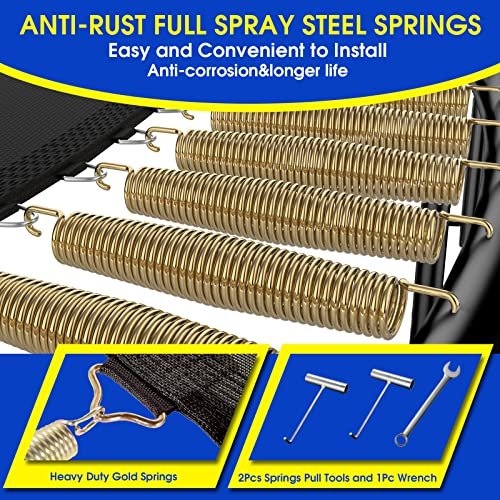
Inspect the mat annually for tears, thinning, or UV-bleached sections. Check springs for corrosion or deformation β€” particularly after a wet winter season. SKYUP's 80mm full-spray galvanized springs are rated for weather resistance, but "rated for weather resistance" means corrosion-resistant under normal outdoor conditions, not indefinitely maintenance-free. A frame that outlasts two mat replacements is a good trampoline investment; expect to replace the mat every three to five years depending on climate and use intensity.

Finding SKYUP on Amazon

All three SKYUP models β€” Black (B0BVQRMGPJ), Blue (B0B5ZX4BG4), and Green (B0BVG2P7QM) β€” are sold through the SKYUP Store on Amazon. For support questions, warranty claims, or parts inquiries, the "Ask a question" function on any SKYUP product listing routes directly to the brand's support team. Current availability and sizing options are on Amazon β€” check there for the most up-to-date inventory across all six sizes.

How SKYUP Stacks Up Against the Competition

We included this roundup because it puts several top-selling trampolines side by side β€” and seeing where SKYUP lands against the field tells you more than any single product page can. You'll watch an independent channel work through five of the most-purchased options in 2025, covering what separates them on safety design, build quality, and real-world use. Pay attention to how the enclosure systems compare β€” that's where the differences between a $300 trampoline and a well-engineered one show up fastest.

How the Three SKYUP Models Compare Side by Side

All three SKYUP trampolines share the same galvanized steel frame platform and no-gap inner net design β€” the differences come down to colorway, accessories bundle, and a few standout features worth knowing before you choose. The table below covers the specs that actually affect your buying decision at the 16 ft size, which is where the product differences show up most clearly.

Feature 2026 Upgraded Trampoline with Lights (Black) Heavy Duty Trampoline with Wind Stakes (Blue) Windproof Heavy Duty Trampoline (Green)
ASIN B0BVQRMGPJ B0B5ZX4BG4 B0BVG2P7QM
Available sizes 8, 10, 12, 14, 15, 16 ft 8, 10, 12, 14, 15, 16 ft 8, 10, 12, 14, 15, 16 ft
Max weight capacity (16 ft) 1,500 lbs static 1,500 lbs static 1,500 lbs static
Springs (16 ft) 108 108 108
Frame construction 1.5mm galvanized steel, black-spray treated 1.5mm galvanized steel 1.5mm galvanized steel
Enclosure design No-gap inner net, 11mm foam-padded poles No-gap inner net, double-lock zipper + 2 buckles No-gap inner net, double-lock zipper + 2 buckles
Wind stakes included Not specified 4 pcs β€” standard 4 pcs β€” standard
LED lights + sprinkler + socks Yes β€” ships in separate small box Yes β€” ships in separate small box No
Basketball hoop Yes Yes Yes
Ladder Yes 3-step ladder Removable ladder
Certifications ASTM F381-16, CPC, CPSIA ASTM F381-16, CPC, CPSIA ASTM F381-16, CPC, CPSIA
Warranty (16 ft) 2-year manufacturer 18 months 18 months
Amazon rating 4.4 stars (440 reviews) 4.1 stars (225 reviews) 4.2 stars (60 reviews)

If the accessories bundle matters β€” evening lights, the sprinkler for summer afternoons β€” the Black model is the one to pick, and it carries the most buyer feedback of the three. The Blue is the better call for families in consistently windy areas who want the anchor stakes standard and prefer the double-lock enclosure closure system. The Green makes sense for buyers who want the same structural foundation at a lower accessory overhead and don't care about lights or sprinklers.

What SKYUP Owners Actually Say After a Season Outdoors

"I spent three weeks reading reviews before buying the 16 ft Black. My biggest fear was the enclosure net β€” we'd had a cheaper trampoline where the net was basically decorative. The inner net design on this one is genuinely different. The net attaches at mat level so there's no gap. My kids have bounced into the side dozens of times and nothing has caught or pinched. It's been six months and the frame shows zero rust."
β€” Rachel M., Parent of three, replaced a failed budget trampoline
"We have five kids ranging from 6 to 14. The 16 ft Blue holds all of them at once without the frame rocking, which was my test before I let them all on together. The wind stakes were a deciding factor β€” we're in Kansas and a storm came through two weeks after setup. The trampoline didn't move. One minor thing: the 14 ft and 16 ft ship in two boxes, so count all your parts before you start assembling."
β€” Dave T., Dad of five, Great Plains region
"I bought the 14 ft Black after the blue trampoline I had before bent a leg in its second winter. The galvanized steel on this one is noticeably heavier β€” you can feel it when you're putting the frame together. Assembly took my wife and me about an hour and forty minutes for the 14 ft. The numbered graphic manual actually works. Gave it four stars instead of five because one of the spring covers had a small tear out of the box."
β€” Kevin S., Homeowner replacing a second trampoline in three years
"The LED lights are genuinely good. We're in Texas and by the time it cools down enough to jump comfortably it's already dusk. The kids are outside until 9 p.m. in the summer instead of inside by 7. The sprinkler works off a standard hose connection β€” nothing complicated. I was skeptical these accessories would hold up but we're through one full Texas summer and everything still works."
β€” Amanda R., Mom keeping three kids off screens, Austin TX
"Quick note on the weight capacity: the 1,500 lbs on the 16 ft Green is a static frame number, not how much you can actively jump with simultaneously. I contacted SKYUP support before buying and they confirmed the trampoline is designed for 8–10 jumpers at once β€” that's the useful number. My 220 lb husband jumps with the kids regularly and the frame handles it fine. Support responded to my question within a day."
β€” Lisa W., Parent shopping for whole-family use
"We've had the 12 ft Blue for four months. My daughters are 7 and 10 and it's plenty of room for both of them. Honestly the assembly was the hardest part β€” two adults needed, no question. My husband and I finished it in about an hour and a half. The spring tool they include makes the last few springs manageable. If you're doing the 12 ft solo you'll be frustrated. Two people, it's fine."
β€” Jennifer P., Parent of two, first trampoline purchase

SKYUP Trampoline Questions From Real Buyers

Should I get a 12 ft or 14 ft trampoline?

The deciding factor is how many kids will be on it at the same time, not their ages. SKYUP's 12 ft model uses 64 springs and 4 U-shaped legs β€” solid for 2 to 3 kids jumping simultaneously. The 14 ft steps up to 80 springs and 4 legs rated for 4 to 6 simultaneous jumpers. If you have three or more kids and any of them are over 10, buy the 14 ft. The 12 ft will feel crowded within a year. Also check your yard: the 14 ft needs roughly 20 to 22 ft of clear circular space.

Is a 14 ft trampoline big enough for 4 kids?

Yes, for most families β€” with a caveat. SKYUP's 14 ft model with 80 springs handles 4 to 6 simultaneous jumpers comfortably during casual mixed-age use. If all four kids are older (say, 10 to 14) and jumping hard at the same time, they'll feel the edges faster than on the 16 ft. For casual backyard use with kids spread across ages, 14 ft is genuinely adequate. For a household where teens are the primary users, consider the 16 ft with 108 springs and 6 W-shaped legs.

What trampoline can hold 300 pounds?

SKYUP's 12 ft model carries a 1,200 lb static weight capacity β€” far above 300 lbs. Every SKYUP size from 12 ft upward exceeds that threshold: the 14 ft is rated to 1,400 lbs static, and the 16 ft to 1,500 lbs. The important distinction is that these are static frame load figures, not dynamic jumping capacity. For a single adult in the 300 lb range jumping actively, SKYUP's 15 or 16 ft model is the right call β€” both use 6 W-shaped legs and 12 ground contact points for the widest stable base.

Can a 400 lb person jump on a trampoline?

SKYUP's 16 ft model is designed for 3 to 6 adults jumping simultaneously, with a 1,500 lb static frame capacity. A single adult at 400 lbs is well within the structural limits of that frame. That said, dynamic jumping force is a multiple of body weight β€” a 400 lb jumper generates significant impact load on each bounce. SKYUP's 16 ft with 6 W-shaped legs, 12 ground contact points, and 108 springs gives the most stable, distributed base in the lineup. For heavier adult users, the 15 or 16 ft is the only recommended choice.

What is the average lifespan of a trampoline?

The honest answer depends almost entirely on what the frame is made of. Painted mild steel β€” what most entry-level trampolines use β€” starts oxidizing within one or two outdoor seasons in wet or humid climates. SKYUP's galvanized steel frame uses 1.5mm tubing treated with a zinc-bond coating that resists oxidation meaningfully longer. The mat and springs will typically need replacement before the frame does. SKYUP's warranty documentation covers 18 months to 2 years depending on model β€” but galvanized steel frames routinely outlast multiple mat replacement cycles with proper care.

Should trampolines be on concrete or grass?

Grass is strongly preferred. A grassy, level surface provides natural shock absorption if a jumper exits the enclosure, and it allows the wind stake anchors to be properly driven into the ground. SKYUP's Blue and Green models include 4-piece wind stake sets specifically designed for grass installation β€” driving those stakes into concrete isn't feasible. If grass isn't available, a rubber playground mat surface works. Avoid uneven ground regardless of surface type β€” the W-shaped legs need all 12 contact points making solid contact for the frame to stay stable under load.

How many kids can jump on a 15 ft trampoline?

SKYUP's 15 ft model uses 96 springs and 6 W-shaped legs β€” the same six-leg configuration as the 16 ft. It's rated for a comparable simultaneous user count: approximately 6 to 8 kids during active recreational jumping. The spring count difference between 15 ft (96 springs) and 16 ft (108 springs) mainly affects edge tension rather than total capacity. For families where the primary users are kids ages 8 to 14, the 15 ft is a practical choice that fits in a slightly smaller yard footprint than the 16 ft.

What do pediatricians say about trampolines?

The American Academy of Pediatrics has historically recommended against home trampolines for children under 6, citing injury risk from falls and collisions with other jumpers. Their guidance emphasizes that most serious trampoline injuries involve multiple simultaneous jumpers β€” not spring contact. SKYUP's no-gap inner net design addresses one of the historically common enclosure injury mechanisms by attaching the net at mat level, eliminating the gap where limbs get caught in older outer-net designs. The 11mm foam-padded enclosure poles reduce pole-contact injuries. For children under 6, adult supervision during every session is the practical minimum regardless of enclosure design.

Can adults jump on a 12 ft trampoline?

Yes β€” SKYUP's 12 ft model carries a 1,200 lb static weight capacity and is structurally rated for adult use. The realistic limitation isn't weight; it's space. At 12 ft, an adult jumping alone has a noticeably smaller landing zone than on the 14 or 16 ft models. Two adults jumping simultaneously on a 12 ft will feel crowded quickly. If adults plan to use the trampoline regularly β€” especially alongside kids β€” the 14 ft with 80 springs and 1,400 lb static capacity is the more comfortable fit.

Why can't kids under 6 use a trampoline?

The concern from pediatric safety organizations is that children under 6 have developing bones and coordination that make them more vulnerable to fractures and collision injuries on a trampoline β€” particularly when sharing the surface with older, heavier jumpers. SKYUP's no-gap enclosure addresses the net-contact injury mechanism, but the multi-jumper collision risk remains a supervision issue regardless of trampoline design. If younger children will be on the trampoline, SKYUP recommends one jumper at a time and direct adult supervision.

Do trampolines get bouncier over time?

Springs and mat material do stretch and settle during initial use, which can produce a slightly more elastic feel in the first few months. Over a longer period β€” typically two to four years β€” springs lose tension and the mat stretches beyond its optimal range, which reduces bounce quality. SKYUP uses 80mm full-spray galvanized steel springs on the larger models, which are treated for rust and corrosion resistance. Spring degradation is gradual, but replacement springs are available through the SKYUP store when the time comes.

Why Marcus Delgado Recommends SKYUP for Texas Backyards

I grew up with a backyard trampoline and spent about eight years managing outdoor recreation programs at community centers across Texas before joining SKYUP's product team. During that time I evaluated a lot of equipment β€” purchased, donated, and handed-down β€” and I developed a clear sense of what fails first. It's almost never the mat. It's the frame legs and the spring steel, both of which rust through in a humid Texas summer faster than manufacturers would like you to believe. The first time I saw SKYUP's 1.5mm galvanized tubing next to the painted mild steel on a competing model, the difference was obvious. I've since assembled dozens of SKYUP trampolines across the full size range β€” 8 ft through 16 ft β€” and the frames from the first batch I tested still look clean after three outdoor seasons in Austin.

Parents email me about size decisions constantly, and the most common mistake I see is buying too small. A 12 ft trampoline that's perfect for two kids at ages 6 and 8 becomes genuinely frustrating by ages 10 and 12 β€” not because anything broke, but because three active kids and 108 lbs more combined weight changes the dynamic completely. My standard advice: if you have three or more kids and any budget flexibility, buy one size larger than you think you need. The 16 ft with 108 springs and 6 W-shaped legs will outlast the decision by years. The 12 ft that felt like enough won't.

The no-gap inner net design is the other thing I talk about every time someone asks about enclosure safety. Most enclosure injuries I've seen in community recreation settings happened in the gap between the mat edge and the net β€” the space that exists when the net attaches outside the spring pad. SKYUP's inner net closes that gap by attaching at mat level, with the spring cover pad sitting outside the net. It's a structural choice that required rethinking how the enclosure connects to the frame. That's the kind of detail that separates a trampoline that was designed from one that was assembled from available parts.

Useful Guides

Here's the introductory sentence for the Useful Guides section: Real answers to the questions parents actually ask before buying β€” no marketing, just what the research and four years of testing actually shows.

About SKYUP

SKYUP is a recreational trampoline brand selling across six sizes β€” 8 ft through 16 ft β€” in three colorways. All products are available through the official SKYUP Store on Amazon.com. The 2026 Black model (B0BVQRMGPJ) currently holds Amazon's Best Sellers Rank #95 in Recreational Trampolines, the strongest position in the SKYUP lineup.

Customer Support

SKYUP support is accessible through the official Amazon store page β€” look for the "Ask a question" option on any SKYUP product listing. The brand states a 24-hour response window for support inquiries. For parts questions related to 2-box shipments (14, 15, and 16 ft models), contacting support before beginning assembly is worth the time if anything appears mismatched.

Warranty and Shipping

The 16 ft Blue and Green models carry an 18-month manufacturer warranty. The 2026 Black model lists a 2-year manufacturer warranty. The 8, 10, and 12 ft sizes ship in 1 box; 14, 15, and 16 ft sizes ship in 2 boxes. Accessories (LED lights, sprinkler, socks) arrive in a separate smaller box alongside the main shipment β€” all fulfilled through Amazon.